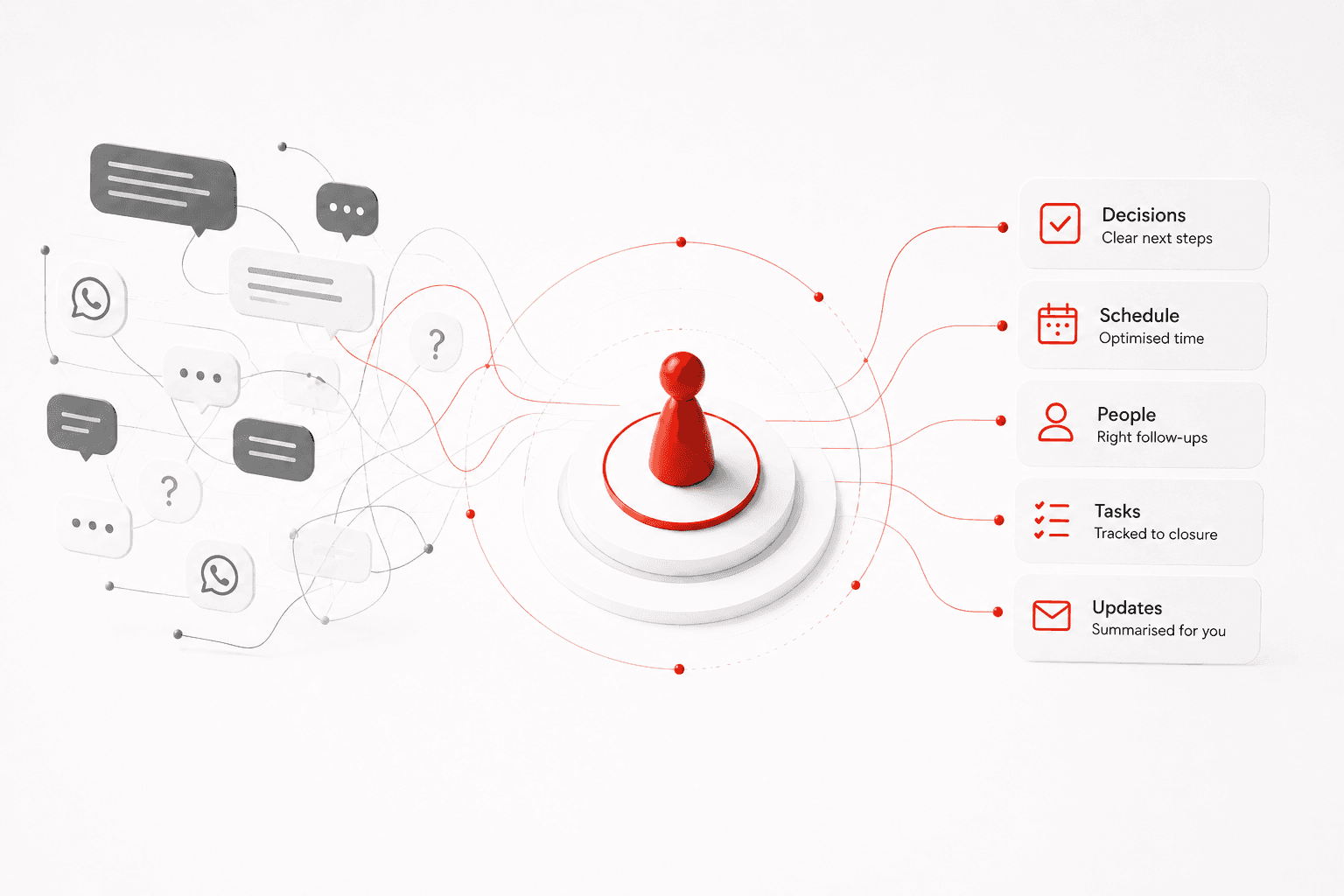
Why most AI assistants fail (what a real executive assistant does)

There is a version of a WhatsApp AI assistant that actually works. And then there is what most people end up with.
Most tools respond when you ask them something. That’s it.
- They have no idea what is happening in your actual conversations.
- They are not catching the commitment someone made in a group chat.
- They are not flagging the follow-up that has been sitting for three days. They are waiting for you to tell them what to do.
That is not an assistant. That is just a bot completely dependent on you.
This article breaks down where things go wrong, what it is costing you, and what a real WhatsApp AI executive assistant actually does differently.
TL;DR
|
Why do most WhatsApp AI assistants fail in real-world use?
The honest answer is that most of them are bots with a better name.
They sit on a separate number. You go to them when you need something, they respond, and that is the extent of it.
They have no idea what is happening in your actual WhatsApp conversations. The commitment someone made in your group chat this morning, the follow-up sitting unanswered for days, the scheduling conflict you are about to walk into — none of it is on their radar.
And because they respond when you ask, they feel like they are working. That is the trap.
Here is where things actually break down.
1. No conversation context
Everything happening in your chats is invisible to them unless you manually tell them about it.
A client says, "I will send the contract over by Thursday" in a group chat. A basic WhatsApp AI tool has no idea that happened. You would have to forward the message, explain the context and ask it to track it.
At that point, you are doing all the work yourself.
2. Reactive by design
They do not act until you trigger them. The burden of noticing things, catching commitments and flagging follow-ups sits entirely with you.
You are doing the thinking. They are just executing the last step.
3. The separate number problem
When your assistant lives on a different number, it is blind to everything on yours.
Your group chats, your one-on-ones — all invisible. You would have to manually forward every relevant message to it, which defeats the purpose entirely.
4. Command dependency
Ask them to set a reminder in a specific format and they do it. Talk to them the way you would talk to a real person and they fall apart.
"Hey remind me about the Priya proposal thing if I don't hear back by Wednesday" is too human for most of these tools. You end up adapting your language to fit the tool instead of the other way around.
5. No cross-tool awareness
They live in isolation from your calendar, email and files.
A meeting discussed in a WhatsApp thread, an email referenced in a group chat, a document shared two days ago — all outside their reach. They can only act on the narrow slice of information you hand them directly.
What is the hidden cost of using the wrong WhatsApp AI assistant?
This is the part most people do not think about until something goes wrong.
When a tool fails obviously you notice and move on. The expensive failures are the quiet ones.
The tool is running, it is responding to commands, it looks like it is working. That appearance of working is exactly what makes it dangerous.
You think your follow-ups are covered. A lead asked for a proposal last week. You told your assistant to remind you.
But the lead also sent a follow-up message in a group chat two days later that your assistant never saw. You miss it. The lead goes cold.
Your assistant technically did what you asked. It just could not see the full picture.
That false sense of security costs more than having no tool at all.
1. Time spent managing instead of delegating
Bad tools need constant maintenance. You have to remember what you told it, check whether it actually followed through and pick up whatever it missed. At some point, the overhead of managing the tool outweighs whatever time it was saving you.
2. The opportunity cost
The follow-up that did not go out. The commitment that was forgotten. The deal that stalled because nobody chased.
These things happened while you had something supposedly handling it. That gap between what you expected and what actually happened is where real damage accumulates, in deals, relationships and trust.
AI assistants vs Executive assistants on WhatsApp
The word assistant gets used loosely.
A bot that sets reminders when you ask is called an assistant. A tool that responds to commands is called an assistant. But there is a meaningful difference between something that responds and something that actually works for you.
Here is what that difference looks like:
Most WhatsApp AI assistants | A real WhatsApp AI executive assistant - Perisclaw | |
Where it lives | Separate number you message | Your own WhatsApp number |
Conversation awareness | Only what you tell it directly | Full context of all your chats |
How it works | Responds when triggered | Acts proactively without being asked |
Group chat access | Needs to be added manually | Works across all chats seamlessly |
Connected to | Nothing outside WhatsApp | Calendar, email, files |
Handles | Commands you give it | Commitments, follow-ups, context |
Feels like | A tool you manage | An assistant who works for you |
That shift, from managing a tool to having an assistant, is what most WhatsApp AI products have not figured out yet.
Perisclaw is the only WhatsApp AI executive assistant that ticks every one of these. If you want to see it in action, head to perisclaw.com and get access.
What should a real WhatsApp AI executive assistant actually deliver?
Most people have never experienced a real executive assistant. So they do not know what the bar actually is. They accept what the tool gives them because they have nothing to compare it to.
Here is what good actually looks like.
1. It works without being told
A vendor says, "I will send the contract by Friday" in a group chat. You did not ask anyone to track it.
Perisclaw caught it anyway. Friday comes, nothing arrived — it surfaces the commitment before you even remember to check.
2. It understands plain language
"Remind me about the Priya thing on Friday" works just as well as a formatted command.
With Perisclaw, you talk to it the way you would talk to a real person. No special syntax. No rephrasing to fit the tool.
3. It knows your full context
Meetings get discussed in chat. Documents get shared in groups. Decisions made in conversations affect your calendar.
Perisclaw connects all of this - your chats, your schedule, your email and understands the full picture without you having to brief it.
4. It disappears into your workflow
The best tools are the ones you stop noticing because they just work.
Perisclaw lives inside WhatsApp on your own number. There is no new habit to build, no app to remember to open. You keep working the way you already do and it fits around that.
What questions should you ask before choosing a WhatsApp AI executive assistant?
A lot of people pick a tool based on what it claims to do. A better approach is to ask the right questions before committing.
Here is a practical checklist:
Does it run on my own WhatsApp number or a separate bot number?
Does it read my actual conversations or only what I tell it directly?
Does it work across my group chats without being manually added?
Can I talk to it in plain language or do I need specific commands?
Does it connect to my calendar and email?
Does it work for personal use as well as work?
Can I revoke access and stay in control of my data at any time?
If the answer to most of these is no or only partially, you are looking at a bot. A real WhatsApp AI executive assistant like Perisclaw checks every one of these boxes.
How Perisclaw is built differently from other WhatsApp AI assistants?
Many of the WhatsApp AI tools in this space are built around their own limitations. Perisclaw is built around yours.
The moment you connect it, it appears in your WhatsApp self chat on your own number. No separate account. No briefing required. It starts reading your conversations straight away.
Within the first day, most people have a moment where Perisclaw catches something they would have completely missed.
That is not a feature. That is just what it feels like when something is actually paying attention.
Connect your Google Calendar and the picture gets even fuller. Perisclaw knows your schedule alongside your conversations. It can flag a conflict before you confirm a call. It can find the document someone referenced in a group three days ago.
Everything happens inside WhatsApp. No new app. No dashboard to check. You just work the way you already do.
For the full walkthrough of how to get started, read the setup guide here.
How to set up a WhatsApp AI executive assistant step by step
Frequently asked questions
1. Why do most WhatsApp AI assistants fail?
Most WhatsApp AI assistants fail because they are reactive bots with no awareness of your actual conversations.
They sit on a separate number, respond to commands and have no context of what is happening in your chats. They cannot catch commitments, track follow-ups or act proactively because they were never built to do any of that.
2. What is the difference between a WhatsApp bot and a WhatsApp AI executive assistant?
A WhatsApp bot responds to commands you send it.
A WhatsApp AI executive assistant reads your conversations with full context, acts proactively without being asked, and connects to your calendar and email. The difference is between a tool you manage and an assistant that works for you.
3. How long does it take to see results from a WhatsApp AI executive assistant?
Anyone who has tried this notices a difference within the first week. The fastest wins come from commitment tracking and follow-up reminders. The more context it builds over time, the more useful it becomes.
4. How do I know if my current WhatsApp AI assistant is actually working?
If you are still manually tracking follow-ups, forwarding messages to your assistant or checking whether it did what you asked, it is not working.
A real WhatsApp AI executive assistant reduces your mental load. You should notice things being caught that you did not ask anyone to track.
5. Can a WhatsApp AI executive assistant handle commitments made in group chats?
The majority of WhatsApp AI tools cannot because they live on a separate number and have no visibility into your group chats.
Perisclaw works across all your chats seamlessly, including groups, without needing to be manually added. It catches commitments wherever they are made.