
5 OpenClaw Alternatives to Consider in 2026

OpenClaw is powerful, but after testing it and several of the alternatives, one thing became clear: the best alternative depends on what you actually want from an AI agent.
If you want full control, there are lighter self-hosted options. If security is your biggest concern, there are alternatives built around isolation. And if you simply want an AI assistant without managing servers, gateways, and ongoing maintenance, there are managed options too.
We looked at the most relevant OpenClaw alternatives and picked five that each solve a different problem, so the list maps to your real reason for switching.
TL;DR: Best OpenClaw alternatives worth considering
OpenClaw alternative | Best for | Why consider it? |
|---|---|---|
Perisclaw | A managed AI assistant on WhatsApp | It gives you an OpenClaw-style AI assistant on WhatsApp without requiring you to install, host, or maintain the underlying infrastructure. |
Hermes Agent | A self-hosted OpenClaw replacement | Closest match if you want an autonomous agent you run and control yourself, with a migration path off OpenClaw. |
NanoClaw | Container-based isolation | It is built around isolated containers, making it a strong choice if you want to separate agents and reduce the security risks of running them directly on your system. |
ZeroClaw | A lightweight OpenClaw alternative | It focuses on keeping the agent runtime small and resource-efficient, making it useful for users who find OpenClaw heavier than they need. |
Nanobot | A minimal, hackable AI agent | It offers a much smaller codebase and simpler architecture for people who want an OpenClaw-style agent they can understand and modify themselves. |
Four of the five are open source projects you host yourself, so your real cost is the server plus model usage. Perisclaw is the one managed option here, and it fits when you want the assistant without the infrastructure around it.
Why look for an OpenClaw alternative?
OpenClaw looks great when you first see what it can do. Then you actually start running it. And that's usually when the questions begin.
# Problem 1: You have to maintain it
Running OpenClaw is a job in itself. You set it up, keep the runtime alive, handle updates, fix broken dependencies, and work out what went wrong when something stops working.
Anyone who has gone through setting up OpenClaw for WhatsApp already knows how much of the work lands after the install.
# Problem 2: Security becomes your problem
Give an AI agent access to your files, tools, credentials, and computer, and you need to think carefully about what it can access.
That's fine if you want that level of control. But you also need to set up the right permissions and isolation.
# Problem 3: OpenClaw can feel like overkill
Maybe you don't need a large agent runtime running on your machine.
If you're working with limited hardware or only need a few core capabilities, a lighter alternative can make more sense.
# Problem 4: You want a smaller system
Some developers don't want to learn their way around a large codebase before they can change something.
That's where projects like Nanobot come in. A smaller codebase can be easier to understand, experiment with, and modify.
# Problem 5: You don't want to self-host
And sometimes, you simply don't want another thing to maintain.
You want the AI assistant. You don't want the server, Gateway, configuration, uptime checks, and troubleshooting that come with running one yourself.
Let's take a look at five OpenClaw alternatives that solve these problems.
1. Perisclaw: Best managed alternative to OpenClaw for WhatsApp
If you want an AI assistant on WhatsApp but don't want to install and maintain OpenClaw yourself, Perisclaw is the most relevant alternative on this list.

Perisclaw is a fully managed AI assistant that runs through WhatsApp. You don't need to set up a Gateway, keep a server running, manage a VPS, or troubleshoot a WhatsApp connection every time something breaks.
Instead, you connect Perisclaw and use it from your own WhatsApp chat.
It can handle a wide range of everyday tasks, including:
Tasks and reminders: Create tasks, hold on to commitments, and get a nudge when something is due.
Search and research: Look things up, pull a summary together, and get the answer back in your chat.
Documents and files: Save WhatsApp documents to Google Drive and keep them organized for later.
Google Sheets: Read and update your spreadsheets from a WhatsApp message.
Connected apps: Bring Notion, Slack, Asana, HubSpot, Todoist, and Microsoft 365 into the same chat.
Gmail: Search, read, reply to, and clear your inbox. Here's a full walkthrough of how to manage Gmail from WhatsApp.
Browser mode: Perisclaw opens its own browser and runs online errands. It finds the page, fills in the form, works through the steps, and sends you a live link when it reaches a password or a payment, so you finish that part yourself.
Memory: Hold on to details you want back later, so one message brings them up again.
Custom skills and workflows: Build your own skills for the jobs you repeat, using custom skills.
OpenClaw hands you the runtime. Perisclaw hands you the assistant with the runtime already taken care of.
Why choose Perisclaw over OpenClaw?
With OpenClaw, you're responsible for setting up and maintaining the environment that runs your agent. Perisclaw handles that infrastructure for you.
That makes Perisclaw particularly useful if WhatsApp is already where you work, and you want an AI assistant there without turning its setup and maintenance into another project.
Choose Perisclaw if: you want a managed AI assistant on WhatsApp that can handle tasks, reminders, research, email, files, connected apps, and other everyday workflows without requiring you to run the underlying infrastructure.
Test it on something you’d do today. Connect Perisclaw to your WhatsApp, then send it one real task, like “find the invoice the client sent last week” or “remind me to call the bank at 4.” |
|---|
2. Hermes Agent: Best for a self-hosted OpenClaw replacement
Hermes Agent is one of the closest alternatives to OpenClaw if you want to keep the same basic model: an autonomous AI agent that you run yourself and give access to tools, skills, memory, and external services.

That makes it a more natural OpenClaw replacement than general-purpose AI assistants or workflow automation platforms.
Hermes is particularly interesting if you've already built an OpenClaw setup and want to experiment with another agent runtime. It also includes tooling for migrating parts of an existing OpenClaw setup, including settings, memories, skills, and API keys.
Why choose Hermes Agent?
The appeal isn't that Hermes removes self-hosting. It gives you another implementation of the self-hosted agent model.
If you want to retain control over your infrastructure but don't want to stay with OpenClaw, Hermes is one of the strongest alternatives to investigate.
Choose Hermes Agent if: you want a capable, self-hosted OpenClaw-style agent with control over the underlying runtime.
3. NanoClaw: Best for container-based isolation
One of the biggest concerns with autonomous AI agents is what happens when you give them access to your computer, files, credentials, and other tools.

NanoClaw addresses that problem with container-based isolation. Agent workloads can run in separate containers instead of operating directly on your host system.
That makes it particularly relevant if security is one of the reasons you're looking beyond OpenClaw.
Why choose NanoClaw?
Its main appeal is the isolation model.
Agents run in isolated containers.
The agent's environment can be separated from your main machine.
You get a more contained setup for running autonomous workloads.
You're still responsible for the technical setup and maintenance, so NanoClaw doesn't solve the self-hosting problem. It solves a different problem: how much access your agent gets to the environment it runs in.
Choose NanoClaw if: security and isolation are your main reasons for looking beyond OpenClaw.
4. ZeroClaw: Best for a lightweight OpenClaw alternative
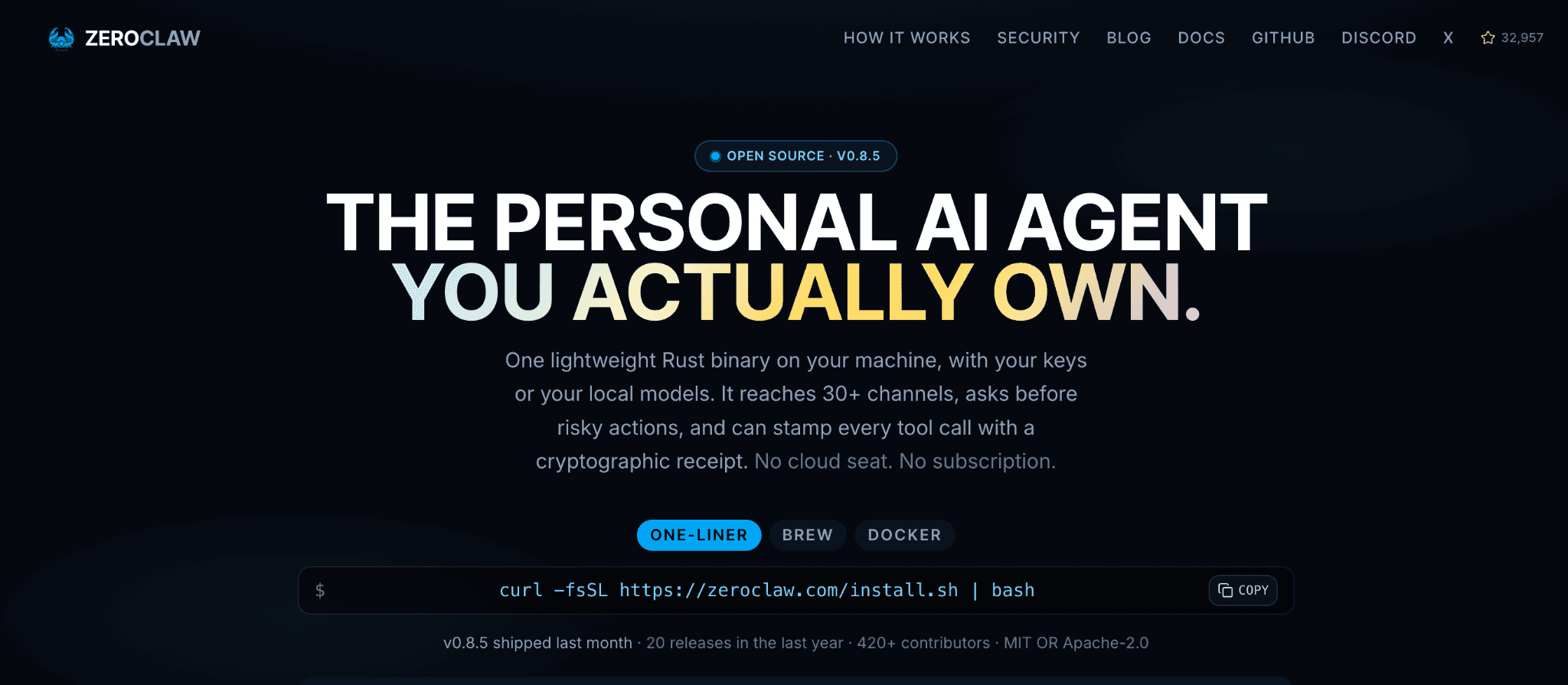
If OpenClaw feels heavier than you need, ZeroClaw takes a much more lightweight approach.
Built in Rust, ZeroClaw focuses on a small resource footprint and fast execution. That makes it interesting for developers who want to run an AI agent on lower-powered hardware, inexpensive servers, or other constrained environments.
Why choose ZeroClaw?
The main reason is resource efficiency.
Instead of running a larger agent runtime when you only need a smaller one, ZeroClaw is designed to keep the underlying footprint low.
That can be useful when you're:
Running an agent on limited hardware
Trying to keep infrastructure costs down
Building an agent for an edge or embedded environment
Experimenting with a lightweight runtime
Choose ZeroClaw if: you want an OpenClaw-style agent that uses fewer resources and is easier to run on constrained infrastructure.
5. Nanobot: Best for a minimal, hackable AI agent
Nanobot is aimed at developers who like the idea of OpenClaw but want something much smaller and easier to understand.

Its codebase is significantly smaller than OpenClaw's, making it easier to inspect, modify, and experiment with. It still provides the building blocks you'd expect from a personal AI agent, including tools, memory, messaging channels, and model integrations.
Why choose Nanobot?
The biggest advantage is simplicity.
You don't have to understand a huge codebase before you can start modifying the agent. For developers who want to learn how these systems work or build their own version, that makes Nanobot a more approachable starting point.
It also makes sense if you want to experiment with your own agent architecture rather than adopt a large, established framework.
Choose Nanobot if: you want a small, understandable OpenClaw-style agent that you can inspect, modify, and build on yourself.
Want a managed OpenClaw alternative for WhatsApp?
If you like what OpenClaw can do but don’t want to run it yourself, Perisclaw gives you that kind of assistant inside the WhatsApp chat you already use. There’s no server, Gateway, or connection to keep alive.
Getting started takes three steps:
Connect Perisclaw to your WhatsApp.
Link the apps you use most, like Gmail, Google Drive, or Notion.
Hand it your first job, such as clearing your inbox or setting tomorrow’s reminders.
Set up Perisclaw in WhatsApp →
OpenClaw Alternatives FAQs
1. What is the best alternative to OpenClaw?
Perisclaw is the best OpenClaw alternative for WhatsApp. It gives you a managed AI assistant on WhatsApp without requiring you to host or maintain the underlying agent infrastructure. For a self-hosted replacement, Hermes Agent is one of the closest options.
2. What is the closest alternative to OpenClaw?
Hermes Agent is one of the closest OpenClaw alternatives for users who want a self-hosted autonomous AI agent. It provides tools, skills, memory, and integrations while keeping the runtime under your control.
3. Is there a simpler alternative to OpenClaw?
Yes. Perisclaw is a simpler alternative if you want a managed AI assistant instead of a self-hosted runtime. Nanobot is a simpler option for developers who want a smaller codebase they can inspect and modify.
4. What is the best self-hosted alternative to OpenClaw?
Hermes Agent is one of the strongest self-hosted OpenClaw alternatives. It gives you control over the agent runtime, tools, skills, configuration, and infrastructure.
5. What is the best lightweight OpenClaw alternative?
ZeroClaw is a strong lightweight OpenClaw alternative. Built in Rust, it focuses on low resource usage and works well for constrained hardware, inexpensive servers, and lightweight deployments.
6. Is there a managed alternative to OpenClaw?
Yes. Perisclaw is a managed OpenClaw alternative built for WhatsApp. It handles the hosting and underlying infrastructure, so you can use the assistant without running your own Gateway or server.
7. What is the best OpenClaw alternative for WhatsApp?
If WhatsApp is where you want your assistant, go with Perisclaw. It’s built for WhatsApp from the ground up and handles the hosting, Gateway, and connection for you, so you can start using it straight from your chat.
8. Is OpenClaw worth self-hosting?
OpenClaw is worth self-hosting if you want full control over the runtime, infrastructure, tools, and configuration. If you don't want to manage servers, updates, uptime, and connections, use a managed alternative such as Perisclaw.
9. Why are people looking for OpenClaw alternatives?
People look for OpenClaw alternatives because they want less maintenance, stronger isolation, lower resource usage, a smaller codebase, or a managed setup. Hermes Agent, NanoClaw, ZeroClaw, Nanobot, and Perisclaw address those specific needs.
10. What are the main problems with OpenClaw?
The main challenges with OpenClaw are setup, self-hosting, maintenance, security, resource usage, and ongoing infrastructure management. WhatsApp deployments can also require additional workarounds for connections and session stability.